

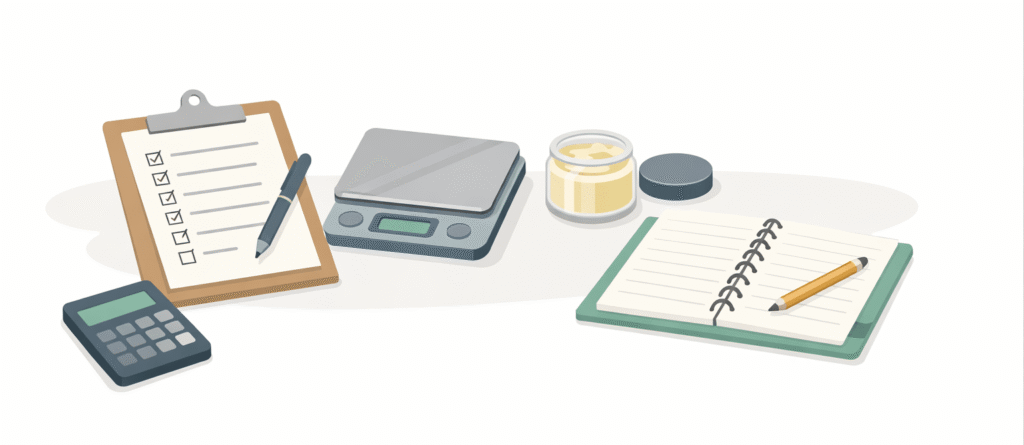
Taking time to plan before you measure or mix ingredients makes your DIY beauty projects run more smoothly. By organizing ratios, batch sizes, and calculator results ahead of time, each step is easier to follow and repeat. Planning also helps you waste less and get more reliable results.
A successful DIY beauty project begins well before you start mixing ingredients. Planning helps you avoid wasting materials, getting inconsistent results, or ending up with confusing measurements. No matter if you’re making a scrub, balm, or lotion, having a clear plan keeps things calm and repeatable. It also makes it much easier to fix problems if something doesn’t turn out as expected.
This step-by-step guide will help you plan your DIY beauty project from start to finish. You’ll learn how to set your goal, pick the best way to measure, use calculators with confidence, keep track of your choices, and test small batches before making more. If you already use calculators, this guide will show you how to fit them into a simple workflow instead of jumping between notes and unfinished recipes.
Quick takeaway: When you plan your DIY beauty project before mixing, you waste less, get more consistent results, and find it easier to understand calculator outputs. This helps you save time and materials while making products you can trust and repeat.
Planning Checklist (Before You Mix)
- Define the goal (texture, firmness, or use case)
- Confirm the product type (scrub, balm, or lotion)
- Choose one measurement system (weight or volume)
- Decide on a test batch size.
- Select the appropriate calculator.
- Write down ratios and calculated quantities.
- Prepare tools and containers.
Step 1: Define the Goal of Your Project
Every DIY beauty project is easier when you can describe the result you want in one sentence. Your goal keeps you focused and prevents “random tweaking” halfway through. It also helps you choose the right ratios, tools, and batch size before you spend any ingredients.
Examples of clear goals include:
- “I want a thick, scoopable sugar scrub that doesn’t separate quickly.”
- “I want a firm balm that holds its shape in warmer rooms.”
- “I want a lightweight lotion texture for daily use.”
- “I want a small batch that I can test for texture before making gifts.”
If you’re making scrubs, it helps to decide what texture you want, like whether you prefer it more gritty or more silky, or more oily or more exfoliant-heavy. This is where thinking about ratios is useful, since it’s closely tied to understanding texture through scrub ratio calculations.
Quick check: Can you describe your end result without listing ingredients? If yes, your goal is clear enough to plan properly.
Step 2: Decide What You’re Making (Scrub, Balm, or Lotion)
Before you do any maths, clarify the product type, because the product type affects everything: ratios, measurement precision, and how you should interpret calculator outputs. Scrubs tend to be ratio-driven and forgiving, balms are simple but sensitive to small changes, and lotions often require more precision and consistent scaling.
If you’re still deciding which calculator style fits best, these posts help you choose tools that match the project rather than forcing a one-size-fits-all approach:
- Choosing the Right DIY Beauty Calculator for Your Project
- Why Use DIY Beauty Calculators Instead of Guessing Recipes
With your product type and approach clarified, move on to choosing your measurement system.
Step 3: Choose Your Measurement System (Weight vs Volume)
One of the most important planning choices is deciding if you’ll measure by weight (grams or ounces) or by volume (teaspoons, tablespoons, or cups). Measuring by weight is usually more reliable because ingredients act differently in a spoon than on a scale. Fine powders, waxes, butters, salts, sugars, and thick oils can settle or pack in a spoon, so volume measurements can change from batch to batch.
If you want a deeper explanation of why this matters, start here: Understanding Weight vs Volume in DIY Beauty Mixing.
Now that you’ve picked a measurement system, review how these choices fit together as your planning takes shape.
Planning Overview: How the Decisions Fit Together
| Planning Decision | What You Choose | Why It Matters |
|---|---|---|
| Project goal | Texture or outcome | Guides all later decisions |
| Product type | Scrub, balm, or lotion | Determines ratio and precision needs |
| Measurement system | Weight or volume | Improves repeatability |
| Batch size | Test or final batch | Controls waste and scalability |
| Ratios | Ingredient balance | Controls texture and structure |
Planning Flow (At a Glance)
| Goal → Define texture or outcome |
| Product Type → Scrub / Balm / Lotion |
| Measurements → Weight or Volume |
| Ratios → Choose starting balance |
| Calculator → Model quantities |
| Test → Small batch evaluation |
| Document → Record final version |
Step 4: Gather Tools and Set Up Your Workspace
Planning is more than just doing the math. It also helps you avoid making rushed or messy decisions. Before you start mixing, gather all your materials ahead of time so you don’t have to improvise. Tip: Set up your workspace by putting your tools and containers on a clean, tidy surface so everything is easy to reach when you begin.
- A digital scale (if working by weight)
- Measuring spoons/cups (if working by volume)
- Mixing bowl/jug, spatula/spoon, and a clean work surface
- Containers for your finished batch (plus one spare)
- A notepad or notes app for documenting inputs and results
If you want a simple breakdown of tools and when they matter most, this guide is helpful: DIY Beauty Tools Explained: From Scales to Measuring Spoons.
When your workspace is set up and all tools are ready, you’re prepared to plan exact ratios and batch sizes.
Step 5: Plan Ratios and Batch Size
This is the step where your project becomes measurable. The ratio you choose sets the texture and structure, and your batch size decides how much you’ll make. Planning both together helps you avoid two common problems: making too much of an untested product and wasting ingredients if it doesn’t turn out, or making too little and not being able to repeat it because you didn’t write down the proportions. For example, without planning, you might end up with a big batch of scrub that doesn’t feel right, which wastes materials. Careful planning of ratios and batch size helps prevent this.
For scrubs, ratio planning is particularly important. Even if you tweak the ingredients later, your exfoliant-to-oil balance drives the overall feel. These posts are useful if you want a stronger understanding of proportion logic:
- Why Ingredient Proportions Matter in DIY Beauty Mixing
- Understanding Sugar-to-Oil Ratios in DIY Scrub Calculations
- Oil-to-Exfoliant Balance in DIY Scrub Formulations
Once you’ve compared your calculator results, proceed to the next crucial phase: actually mapping out your mixing plan before you begin.
Planning With vs Without a Defined Ratio
| With Planned Ratios | Without Planned Ratios |
|---|---|
| Texture stays consistent | Texture varies between batches |
| Easy to scale later | Hard to reproduce results |
| Calculator outputs make sense | Numbers feel confusing or wrong |
Step 6: Use a Calculator to Model the Numbers
Once you’ve decided on your ratio and batch size, calculators help you turn your ideas into ingredient amounts. Remember, calculators are planning tools, not final answers. They can scale, convert, and apply ratios consistently, but they depend on the numbers and choices you put in.
These guides support the planning stage especially well:
- Using DIY Beauty Calculators to Scale Recipes Up or Down
- How DIY Beauty Calculators Handle Different Batch Sizes
- Reading and Interpreting DIY Beauty Calculator Results
Planning tip: If you’re testing, run two versions through your calculator (for example, slightly different ratios or a slightly different batch size) and write them down side by side. Seeing options on paper makes it easier to choose intentionally rather than “guess and hope.”
Example: Planning a 100g Test Batch Step by Step
- Goal: Soft, scoopable sugar scrub
- Measurement system: Weight
- Ratio: 2:1 sugar to oil
- Batch size: 100g
The calculator is used to model ingredient quantities before mixing. After testing, the texture feels slightly dry, so the ratio is adjusted and documented for the next batch.
Example Calculator Inputs and Outputs
| Input | Value |
|---|---|
| Batch size | 100g |
| Ratio | 2:1 sugar to oil |
| Measurement system | Weight |
| Output | Result |
|---|---|
| Sugar | ≈ 67g |
| Oil | ≈ 33g |
Step 7: Write a Simple Mixing Plan (Before You Mix)
This is the step most people skip, but it’s what makes DIY projects repeatable. Your mixing plan doesn’t have to be complicated. It’s just a short checklist you can use while you work.
Your plan should include:
- Target batch size
- Measurement system (weight or volume)
- Chosen ratio (and why you chose it)
- Exact ingredient quantities from your calculator
- Mixing order (what you’ll combine first and why)
- Container size and how many jars/tins you’ll fill
If you like a structured approach, this post pairs perfectly with this step: How to Plan DIY Beauty Batches Before Mixing.
Why this matters: A mixing plan prevents “in-the-moment” changes that you can’t repeat later. If you do adjust something, you’ll know exactly what you changed and why.
Step 8: Test a Small Batch and Evaluate the Result
Even if your numbers are perfect, the real test is how the product feels and works, and that takes hands-on testing. Texture, spreadability, absorbency, and how a product holds up over time can’t be fully predicted just by planning.
This is why small batch testing is a core part of planning, not an optional extra. If you want a deeper explanation of what testing protects you from, read: Why Testing Small Batches Matters in DIY Beauty Projects.
When testing, check if the texture matches your goal, if the totals match what you expected, and if the product stays consistent as you use it. For example, if your sugar scrub feels too dry and is hard to spread, you can fix it by changing the oil-to-sugar ratio next time. By adjusting your ratio, batch size, or how you measure based on what you learn, you can keep improving your results without wasting a lot of ingredients.
Step 9: Document Results (So You Can Repeat or Improve)
Documentation is what turns a one-time batch into a recipe you can repeat. After testing, write down what happened, not just what you used.
At minimum, note:
- The final quantities used (including any mid-mix adjustments)
- How the texture turned out compared to your goal
- Any measuring issues (rounding, conversions, confusing outputs)
- Whether you would change the ratio next time
If you’ve ever wondered why a calculator result seemed “right” but the batch didn’t behave as expected, it’s often due to small planning and measuring details. These posts can help you tighten that loop:
- Common Errors DIY Beauty Calculators Help Prevent
- Why Consistent Measurements Matter in DIY Beauty Tools
Who This Guide Is For
- DIY beauty hobbyists planning consistent batches
- Beginners learning to use calculators correctly
- Creators testing small batches before scaling.
Conclusion
Planning a DIY beauty project from start to finish improves accuracy, consistency, and confidence. By defining your goal, choosing a measurement system, selecting the right tools, modelling your numbers, writing a simple mixing plan, and testing small batches, you create a workflow that removes guesswork. The best part is that good planning makes your results more predictable over time — so you spend less time fixing mistakes and more time making products you genuinely like using.
Which Planning Tool Should You Use?
- If you are scaling a batch: use a scaling calculator.
- If you are converting units: use a conversion calculator.
- If you are planning texture: use a ratio calculator.
- If you are planning lotions: use a percentage-based calculator.
FAQs
1. What is the first step in planning a DIY beauty project?
Start by defining the goal of your project, such as the texture you want, the size of the batch, and how you plan to use the finished product.
2. Should I plan with weight or volume measurements?
Weight-based planning is usually more consistent, especially for small batches and ingredients like waxes, butters, salts, and sugars. Volume can vary depending on density and how ingredients pack in a spoon.
3. When should I use a DIY beauty calculator?
Use a calculator during planning when you need to apply ratios, scale batches, or convert measurements. It’s especially useful when you want consistent results across multiple batches.
4. Why is documentation part of the planning process?
Documentation helps you repeat results and troubleshoot changes. If a batch turns out differently, your notes show what changed — measurements, ratios, or tools — so you can adjust intentionally next time.
5. Do calculators replace testing small batches?
No. Calculators help with proportions and scaling, but they cannot predict texture, feel, or performance. Small batch testing confirms real-world results before you scale up.
Informational Notice: All content on mydiybeautycorner.com is provided for general informational purposes only and should be used at the reader’s discretion.
